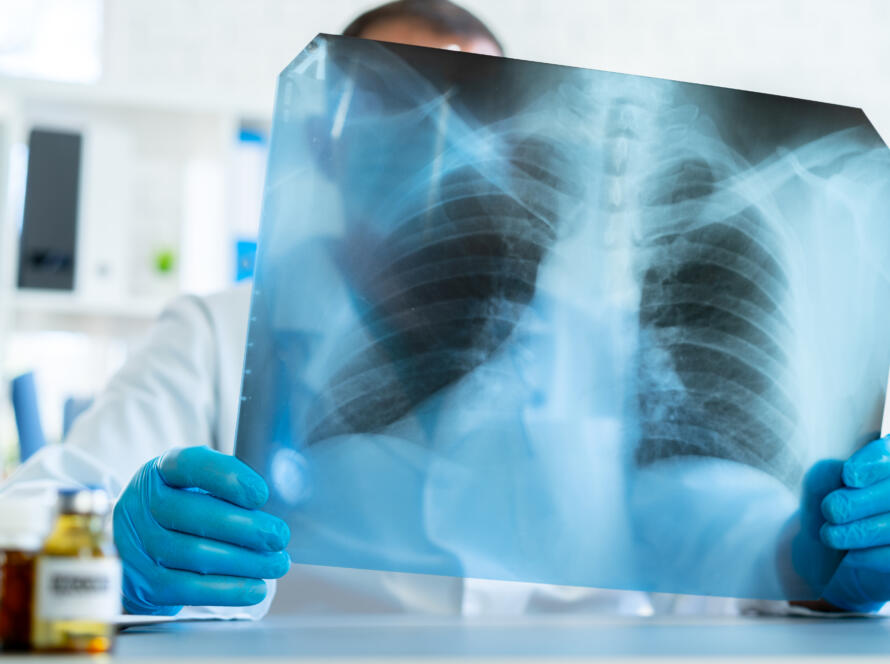
Have you ever felt a sudden, stabbing pain in your chest and difficulty breathing, even while being a young and healthy individual with no prior health issues? The cause of this condition, medically known as pneumothorax and commonly referred to as a collapsed lung, is as follows: pnömotoraks, halk arasındaki adıyla akciğer sönmesi olabilir.
Our lungs are organs that stay inflated within the chest cavity through negative pressure (a vacuum). If air leaks between the lung and the chest wall—due to the rupture of a small air bubble (bleb/bulla) on the lung surface or an external impact—this air accumulates in the chest cavity and prevents the lung from expanding fully.
Why does it happen? Who is at risk?
Spontaneous pneumothorax is primarily divided into two categories:
- Primary Pneumothorax: Usually seen in tall, thin, smoking young males (between ages 16-40). It occurs when small, congenital or acquired air sacs (blebs/bullae) at the apex of the lung rupture.
- Secondary Pneumothorax: Develops due to an underlying lung disease (COPD, emphysema, lung cancer, etc.). The clinical picture in this group of patients can be more severe.
Treatment Methods: Just a Tube or Surgery?
At the Marmara University Faculty of Medicine Thoracic Surgery clinic, we decide on the treatment based on the extent of the collapse and the patient's condition.
- Oxygen Therapy and Observation: In cases of minor collapse, we may keep the patient under observation in the hospital and administer oxygen to allow the air to be absorbed spontaneously.
- Chest Tube (Tube Thoracostomy): This is the most common method. Under local anesthesia, a small tube is inserted into the chest cavity. The accumulated air is drained, ensuring the lung re-expands
However, inserting a tube may not always be a permanent solution.
When is Surgery Necessary? (VATS)
The most frequent question our patients ask is: “Will this disease recur?”. After the first episode, there is a risk of recurrence (in one out of three people). A CT scan can detect cystic structures in someone who has had pneumothorax. While these structures are often seen at the very apex of the lung, cystic structures in other areas must not be overlooked to increase the success of the surgery.
We recommend surgery in the following situations:
- Second Recurrence: If the lung collapses a second time, surgery is recommended.
- Persistent Air Leak: If the lung does not expand within 3-5 days despite the chest tube and air leakage continues in the drain bottle.
- History of Bilateral Pneumothorax: If collapse has occurred on both sides at the same or different times, the currently affected side is operated on.
- High-Risk Professions: For individuals such as pilots, divers, or sailors, surgery may be recommended even after the first episode due to the potential life-threatening risks.
We perform the surgery using the closed method (VATS). Entering the chest with the guidance of a camera, we:
- Remove the air sacs that have ruptured or are prone to rupturing (Bullectomy).
- Perform a Parietal Pleurectomy (removing a portion of the lining of the chest wall) to ensure the lung adheres to this area. This closes the potential space where air could accumulate. This procedure reduces the risk of recurrence to below 5% (equivalent to a healthy individual who has never had the disease).
Frequently Asked Questions – FAQ
Question: Can I smoke again after surgery?
Answer: We must be very clear on this: No. Continuing to smoke significantly increases the risk of recurrence, even if you have had surgery. Pneumothorax might be the final warning your body gives you to quit smoking.
Question: Can I fly?
Answer: Once your lung has fully recovered and this is radiologically confirmed (usually 2-3 weeks after discharge), you can fly. However, pressure changes are risky during the recovery process.
Question: Does it prevent me from doing sports?
Answer: You can return to your normal life and sports after the recovery process (approximately 1 month) is complete. Only sports involving high-pressure changes, such as scuba diving, may be considered risky for a lifetime.
*This content was produced by Dr. Eyüp Halit Yardımcı for patient information purposes and does not serve academic objectives.